
TypeSafe AI launches Jev 'System One' decision model
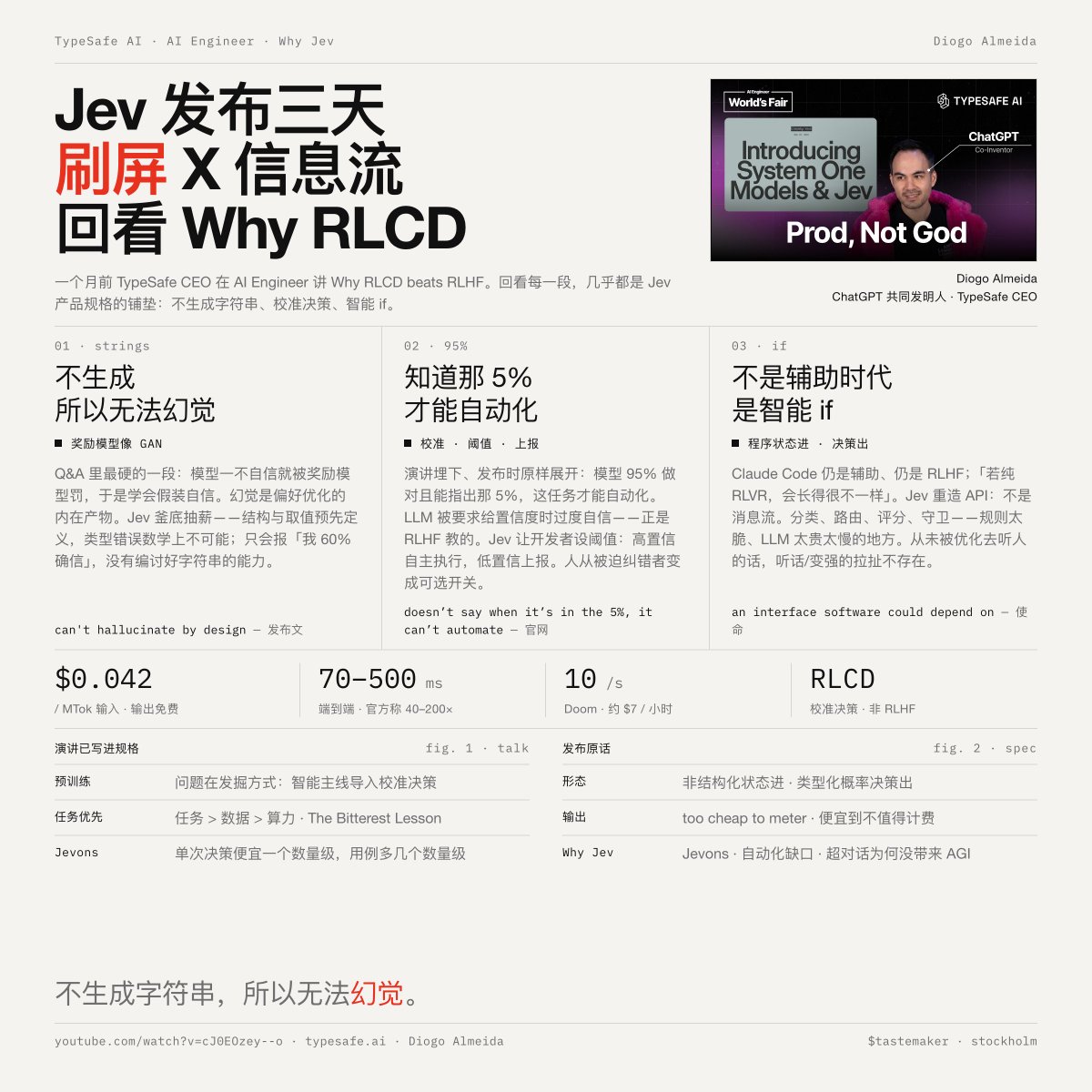
TypeSafe AI, founded by ChatGPT co-inventor Diogo Almeida, launched System One models with Jev, which outputs type-safe structured decisions instead of text. Jev responds in 70-500 ms with claimed 20-200x speed and 40-400x cost advantages; input costs $0.042 per million tokens. Early access is open via waitlist.
Key insights
New model category for in-code decisions
TypeSafe AI, founded by ChatGPT co-inventor Diogo Almeida, who co-authored the InstructGPT, ChatGPT, and GPT-4 papers and worked on RLHF at OpenAI, formally launched the System One model category with its first model, Jev. Jev abandons text generation entirely and is designed for fast decisions inside software: it takes unstructured input and returns type-safe structured results with calibrated probability scores. The company positions it as an intelligent if statement for classification, routing, scoring, extraction, branching, and guardrail tasks where hand-written rules are too brittle and large language models too slow, costly, or unpredictable.
Speed and cost claims of two orders of magnitude
Jev responds in 70 to 500 milliseconds, one to two orders of magnitude faster than frontier models' 3 to 329 seconds, and TypeSafe claims 20 to 200 times greater speed and 40 to 400 times lower cost at comparable intelligence. Input pricing is $0.042 per million tokens, about $42 per billion, with output tokens free. The speed comes from parallel sampling that computes all outputs at once instead of serial token generation, an architecture shift the company compares to Transformers replacing RNNs. TypeSafe acknowledges its Workflow Evals, benchmarked against GPT-6 Astra and Fable 5.1 averages, favor those models, and that extreme multipliers like 193x and 444x represent best cases.
RLCD training removes hallucination by construction
Almeida left OpenAI and spent two years building Jev with a new training method called RLCD, Reinforcement Learning for Calibrated Decisions. His keynote argued that RLHF teaches models to please humans, and that reward models create a GAN-like asymmetry where model uncertainty is punished, so models learn to drop uncertain patterns and fake confidence, making hallucination an intrinsic product of preference optimization. Jev sidesteps this by never generating free text: output structure and values are predefined, type errors are mathematically impossible, and each output carries an epistemically honest probability, enabling confidence thresholds where high-confidence results execute autonomously and low-confidence ones escalate to humans.
Developer positioning as embeddable component
TypeSafe positions Jev as a component for developers rather than a consumer product, solving the need for AI judgment without AI expressiveness. Stated use cases include intelligent branching in workflows such as ticket triage, urgency scoring, and sentiment classification; large-scale document classification, tagging, and field extraction at volumes of millions to billions of records; real-time applications within 100-millisecond latency budgets such as recommendations, dynamic pricing, game AI, and interactive products; and guardrail checking of large model outputs for safety, format compliance, and jailbreaks. Jev is currently in early access through a waitlist.
Demos target latency-bound AI workloads
Two demonstrations illustrate the design target. A Jev-driven bot plays the classic game DOOM in real time at roughly 10 calls per second for about $7 per hour, a call rate frontier models cannot sustain, and a Wikipedia racing task requiring link-by-link navigation shows Jev leading large models' non-reasoning modes in both steps and speed. The System One name comes from Kahneman's fast, intuitive thinking mode, while Jev references the Jevons Paradox, betting that cutting the cost of each AI decision by orders of magnitude will expand total usage by more.
Keynote economics bet on near-free reuse
The launch keynote laid out the product logic behind Jev's unusual pricing. TypeSafe argued task selection matters more than data or compute, that pre-trained intelligence can be routed into calibrated decisions rather than rebuilt, and that software itself has not changed since 2019 despite AI automating software writing. Output tokens are priced as too cheap to bill, the company says it is already profitable and plans further price cuts, and its stated mission is an interface software could depend on. The Jevons framing holds that each order-of-magnitude drop in per-decision cost multiplies the number of viable use cases by more.