
TypeSafe AI Launches Jev 'System One' Decision Model
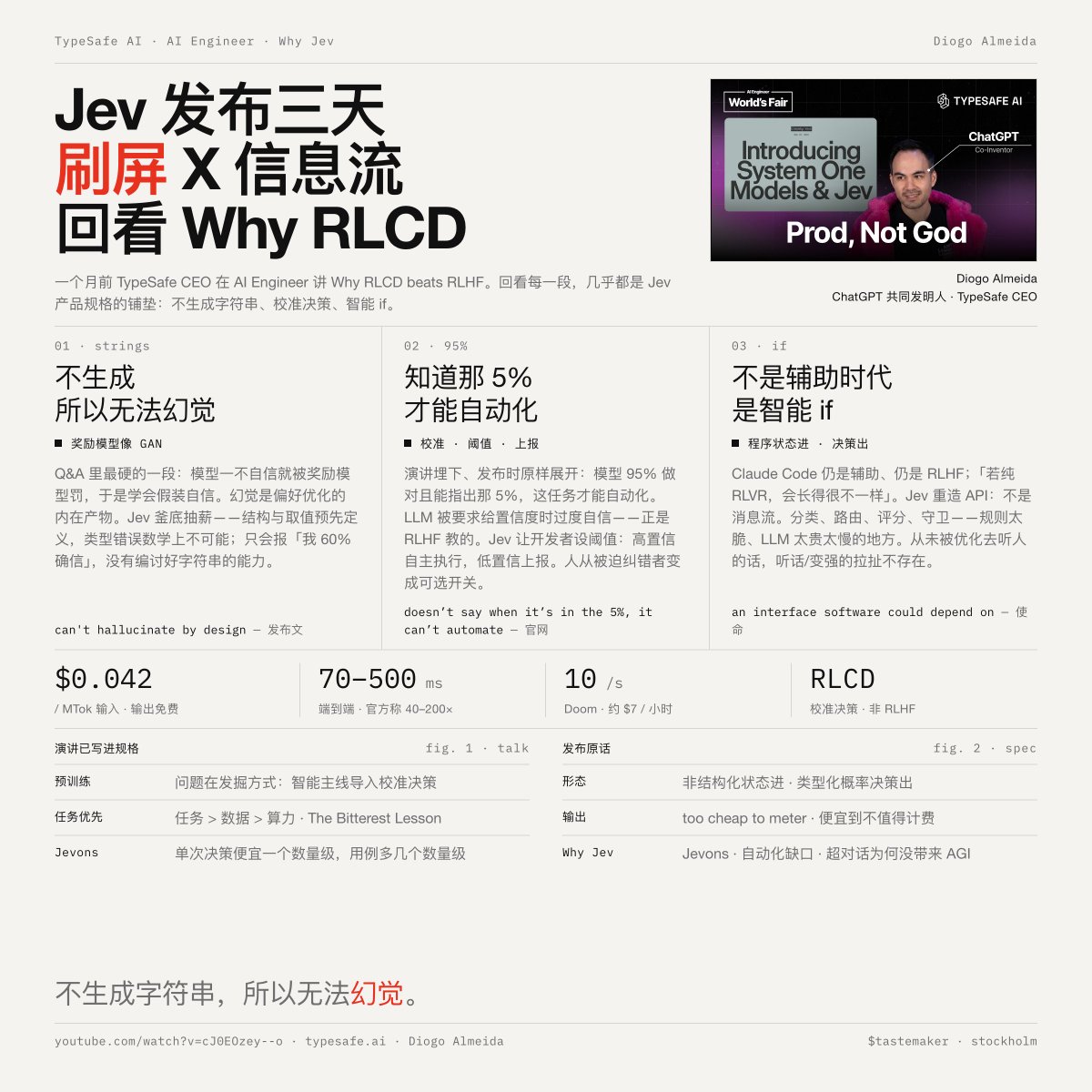
TypeSafe AI, founded by a ChatGPT co-inventor, launched Jev, a System One model that does not generate text but makes type-safe, calibrated decisions in 70-500 milliseconds. It is 20-200 times faster and 40-400 times cheaper than frontier LLMs for tasks like classification and routing.
Key insights
Jev's Technical Innovation: RLCD and No Hallucinations
Jev uses a new training method called RLCD (Reinforcement Learning for Calibrated Decisions), which avoids the preference optimization pitfalls of RLHF. By not generating free text, it mathematically eliminates type errors and hallucinations. Each output includes epistemically honest confidence scores, allowing developers to set thresholds for autonomous execution or human escalation.
Performance and Pricing Compared to Frontier LLMs
Jev delivers 70-500ms response times, compared to 3-329 seconds for frontier LLMs. Input tokens cost $0.042 per million, while output tokens are free. TypeSafe claims the model is 20-200 times faster and 40-400 times cheaper than LLMs of equivalent intelligence, based on their internal Workflow Evals using GPT-6 Astra and Fable 5.1 as references.
Design Philosophy and Market Positioning
Jev is designed as an "intelligent if-statement" for software, not a conversational AI. Its architecture uses parallel sampling instead of token-by-token generation, enabling speed. The name references Jevons Paradox, betting that drastically lower decision costs will lead to massive demand growth. It targets scenarios requiring fast, structured decisions like workflow branching, data processing, real-time applications, and LLM output guards.
Real-World Demos: Doom and Wikiracing
TypeSafe demonstrated Jev's capability in demanding real-time environments. In a Doom demo, Jev controlled AI bots at about 10 queries per second, costing roughly $7 per hour. In Wikiracing, Jev outperformed non-reasoning LLMs in both steps and speed, selecting among hundreds of links to navigate from one Wikipedia article to another.