
TypeSafe AI Launches Jev System One Model
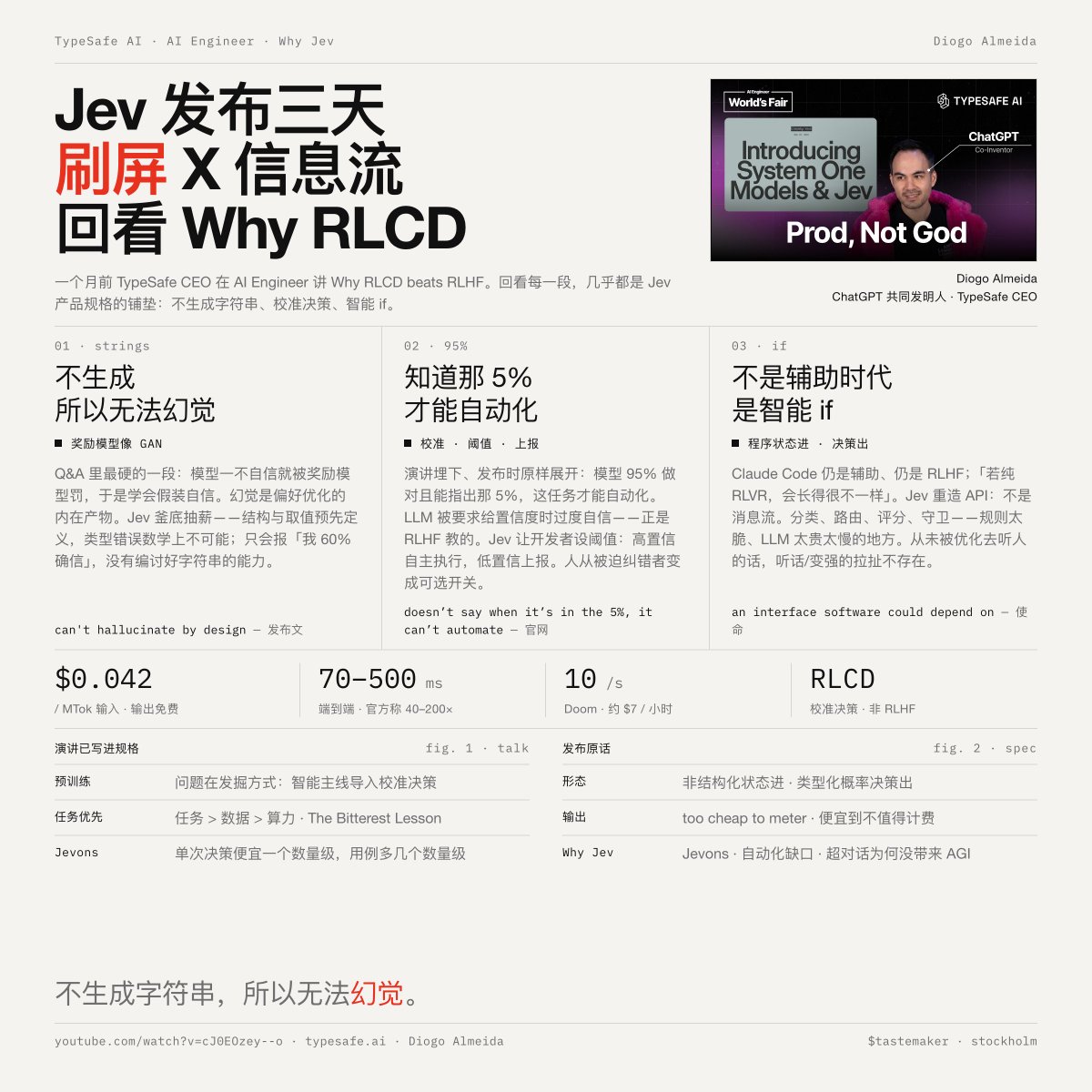
Founded by ChatGPT co-inventor Diogo Almeida, TypeSafe AI launched Jev, a model with no text generation that returns typed decisions with calibrated confidence. It responds in 70 to 500 milliseconds, costs $0.042 per million input tokens with output free, and is available in early access.
Key insights
Jev Redefines AI as a Typed Decision Function, Not a Text Generator
TypeSafe AI, founded by former OpenAI researcher Diogo Almeida, a co-author of the ChatGPT and GPT-4 papers who worked on InstructGPT and RLHF, launched Jev as the first model in a new category the company calls System One models, named after the fast, intuitive mode in Kahneman's Thinking, Fast and Slow. Jev has no text generation capability: it takes unstructured input and returns type-safe structured results with calibrated probabilities, positioned as an intelligent judgment function inside code for classification, scoring, routing, extraction, and branching. TypeSafe states that type errors are mathematically impossible because output structure is constrained at the architecture level, and hallucination therefore does not exist. Almeida spent two years in stealth building Jev with a training method called RLCD, Reinforcement Learning for Calibrated Decisions.
Speed and Cost Claims: 20 to 200 Times Faster, 40 to 400 Times Cheaper
TypeSafe claims Jev is 20 to 200 times faster and 40 to 400 times cheaper than frontier LLMs of comparable intelligence. Response times run 70 to 500 milliseconds against 3 to 329 seconds for mainstream frontier models. Pricing is $0.042 per million input tokens, about $42 per billion tokens, with output tokens free. The numbers come from TypeSafe's own Workflow Evals, which use averaged results from GPT-6 Astra and Anthropic's Fable 5.1 as reference answers; the company concedes this methodology favors those models, so Jev's relative performance may be underestimated, and extreme multipliers such as 193x and 444x represent best cases. The speed comes from parallel sampling that computes all outputs at once rather than token by token, the same parallel-over-serial logic that displaced RNNs.
RLCD Thesis: Pleasing Humans Is the Root of Hallucination
At a keynote titled Why RLCD beats RLHF a month before launch, CEO Diogo Almeida argued that reward models have a GAN-like asymmetry: a model's lack of confidence is easily detected and punished, so models learn to discard uncertain patterns and feign confidence, making hallucination an inherent product of preference optimization. When an LLM does not know, it must fabricate a pleasing string, like the keynote's joke about a fart sound effect praised as ambient music. Jev removes the possibility entirely: it cannot generate free text, only state calibrated confidence such as being 60 percent sure. The keynote adds that existing LLMs are overconfident and inconsistent when asked for confidence, which is exactly what RLHF taught them.
Calibrated Confidence Turns Human Review Into an Optional Switch
The keynote's core product logic: if a model is right 95 percent of the time and can tell you when it is in the 5 percent, the task can be automated. Jev lets developers set thresholds so high-confidence decisions execute autonomously while low-confidence ones escalate to humans, moving people in the loop from forced correctors to optional switches. Each output carries what TypeSafe calls epistemically honest probabilities. Demonstrations include a Jev-driven bot playing DOOM in real time at roughly 10 calls per second for about $7 per hour, and a Wikiracing demo where Jev beat LLM non-reasoning modes in both step count and speed while choosing among hundreds of links.
Positioned as a Direct Opposite of the Claude Code Era
The keynote framed current coding agents, including Claude Code, as still belonging to the assistance era and still trained with RLHF, arguing that a purely RLVR product would look very different. Jev goes further by rebuilding the API shape itself: structured program state in, typed decisions out, replacing message streams. Because Jev was never optimized to obey human phrasing, the keynote claims the pull between agent capability and obedience does not arise in its framework. The mission statement, 'AI needs an interface software could depend on,' is presented as the engineering version of 'smarter software, not just-in-time software.'
Target Market: The Intelligent If Statement in Software Pipelines
TypeSafe positions Jev for tasks where handwritten rules are too brittle and LLMs too slow, expensive, or unreliable: classification, routing, scoring, extraction, branching, and guards, which the company calls intelligent if statements. Concrete scenarios include routing support tickets by team, urgency, and sentiment; tagging and field extraction across massive document volumes; real-time uses such as recommendations, dynamic pricing, and game AI at 100-millisecond latency; and guardrails, where Jev checks LLM outputs for safety, format compliance, or jailbreaks, since it cannot hallucinate and responds extremely fast. Jev is a developer component rather than an end-user product, solving the need for AI judgment without AI expression. The name honors the Jevons paradox: as decision cost drops an order of magnitude, use cases grow by more.
CEO's Coding Agent Essay Questions KV-Cache-Driven Design
In a separate essay, TypeSafe's CEO posed a counterfactual: how would you design a coding agent if LLMs had no KV cache, arguing many standard agent features are patches around cache isolation and per-token billing rather than user value. He calculated that routing simpler steps to Sonnet and returning to Opus costs more than staying on Opus throughout when contexts are long, because caches are per-model and mid-session tokens get re-billed at input price. He also questioned upfront tool declarations, compaction's assumption of shared state, sub-agent state handoff, and restarts. TypeSafe's proposed answer is explicit state with query-aware context rebuild, called meta-attention, enabling cost-aware routing, cheaper sub-agents, progressive tool disclosure, and conditional AGENTS.md files.
Business Bet: Already Profitable and Cutting Prices
The keynote and company blog frame the strategy as a bet on a new task space rather than a price war over unit intelligence. The revised Bitter Lesson holds that task choice matters more than data or compute; Jev does not rebuild intelligence but pipelines pretrained models' intelligence into calibrated decisions, letting it claim frontier-level intelligence on System One tasks at two orders of magnitude better speed and cost. The company says output tokens are free because they are too cheap to bill, describes itself as already profitable, and pledges further price cuts, expecting total consumption of intelligence to rise as per-decision cost falls, echoing the Jevons paradox that gives the model its name.