
TypeSafe AI launches Jev, System One model for fast decisions
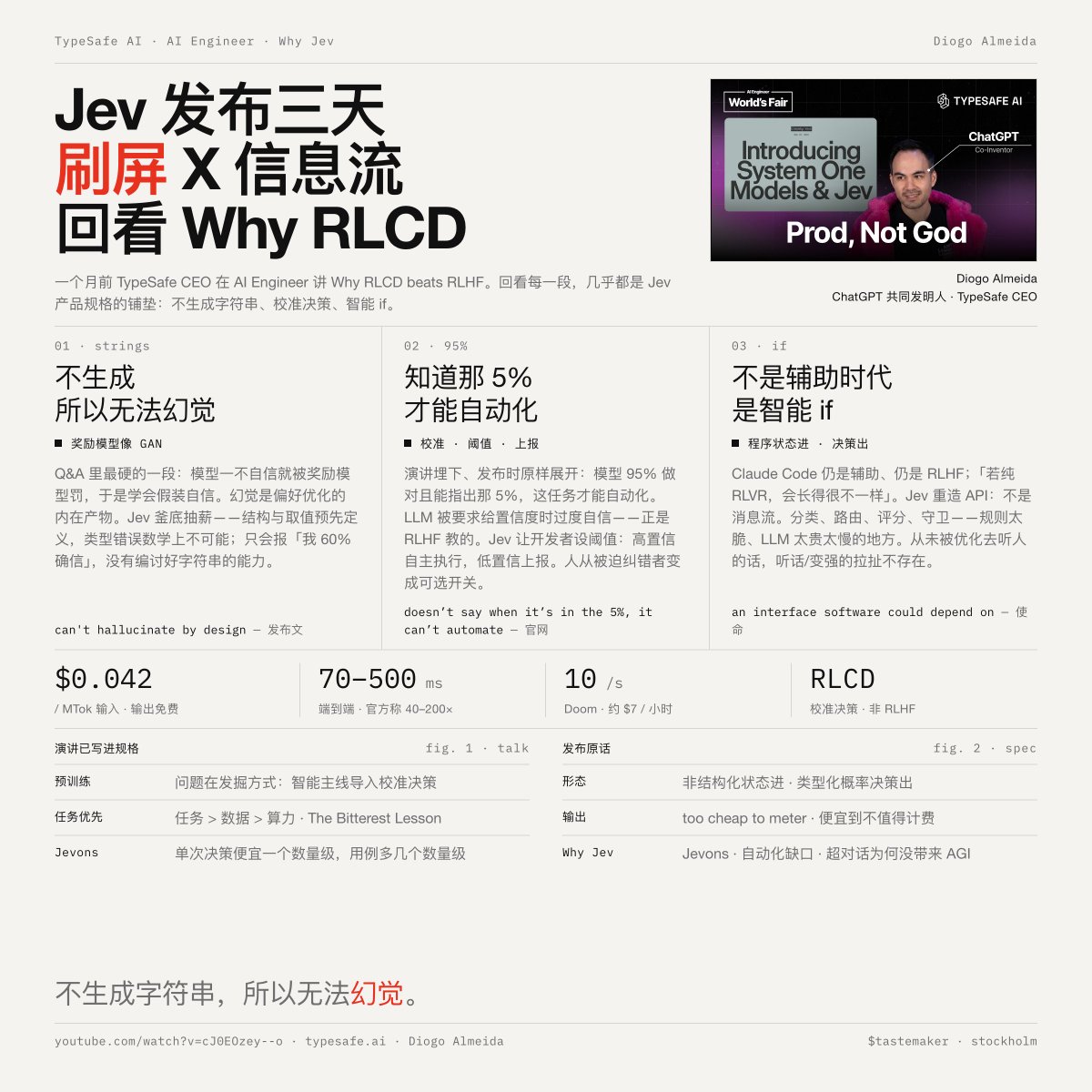
TypeSafe AI, founded by ChatGPT co-inventor Diogo Almeida, launched Jev, a System One model that does not generate text but makes fast, calibrated decisions. Jev outputs structured results with confidence scores in 70-500ms, costs $0.042 per million input tokens with free output, and uses RLCD training to eliminate hallucination. It is designed for software integration as an intelligent if-statement for classification, routing, and extraction tasks.
Key insights
Jev: a new category of AI model for decision-making, not text generation
TypeSafe AI released Jev, the first System One model, which completely abandons text generation. Instead, it takes unstructured data and outputs type-safe structured results with calibrated probabilities. The model is designed for fast, reliable decisions within software systems, such as classification, scoring, routing, and extraction. It cannot write articles or chat, but can serve as an intelligent if-statement in code.
Speed and cost advantages over traditional LLMs
Jev responds in 70-500 milliseconds, compared to 3-329 seconds for frontier LLMs. Input token price is $0.042 per million tokens ($42 per billion tokens), and output tokens are free. TypeSafe claims Jev is 20-200x faster and 40-400x cheaper than equivalently intelligent LLMs, based on workflow evals using GPT-6 Astra and Fable 5.1 as references. The extreme speed comes from parallel sampling, generating all outputs at once instead of token-by-token.
RLCD training eliminates hallucination and ensures calibrated confidence
Jev is trained using RLCD (Reinforcement Learning for Calibrated Decisions), a method developed by founder Diogo Almeida. Unlike RLHF, which encourages models to please humans and thus hallucinate, RLCD trains the model to output only predefined structures with honest probabilities. Type errors are mathematically impossible due to architectural constraints. The model cannot generate free text, so it cannot hallucinate; it can only express confidence levels, e.g., 'I am 60% sure.'
Use cases: smart if-statements, guardrails, real-time applications
Jev is positioned for scenarios where a code flow needs an intelligent judgment but not a human-readable response. Key use cases include: intelligent branching in workflows (e.g., ticket routing, urgency assessment), large-scale data processing (classification, extraction), real-time applications (game AI, dynamic pricing), and guardrails for LLM outputs (safety checks, format validation). The DOOM demo showed Jev controlling a game bot at ~10 queries per second for ~$7/hour.
Pricing philosophy based on Jevons Paradox
The model is named after William Stanley Jevons, referencing the Jevons Paradox where increased efficiency leads to greater total consumption. TypeSafe bets that making AI decisions extremely cheap will cause usage to explode. Output tokens are free, and the company claims it is already profitable and will continue lowering prices. The goal is to make AI decisions so inexpensive that they become ubiquitous in software, replacing brittle rule engines.
Founder's background and departure from RLHF paradigm
Diogo Almeida co-authored the ChatGPT and GPT-4 papers at OpenAI, where he worked on InstructGPT and RLHF. He left to build Jev because he believed RLHF makes models unreliable for automation by teaching them to please humans. His talk at aiDotEngineer outlined how reward models create a GAN-like asymmetry, forcing models to fake confidence. Jev's RLCD directly addresses this by not optimizing for human approval but for calibrated decisions.