
TypeSafe AI Launches Jev: Ultra-Fast Decision Model
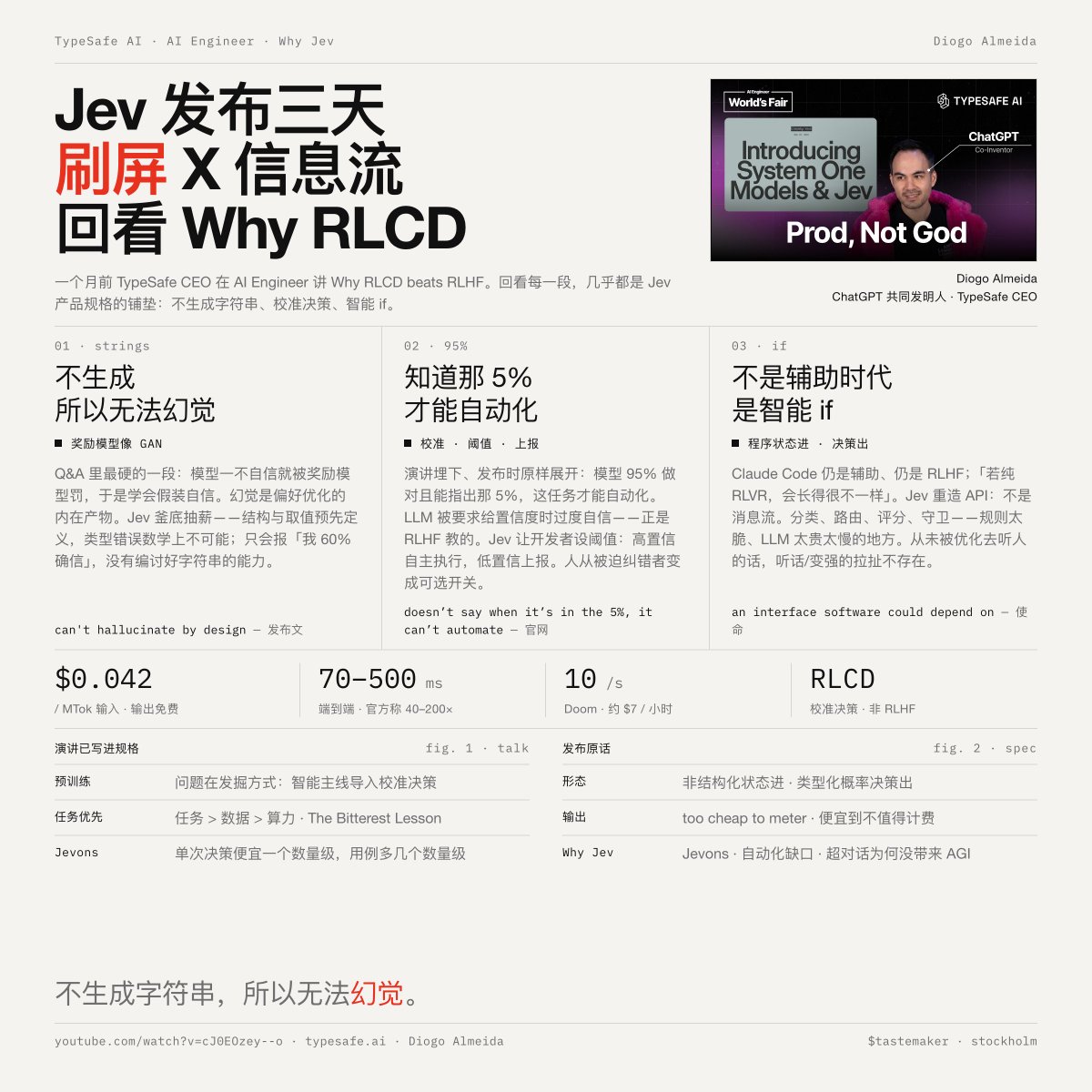
TypeSafe AI, founded by ex-OpenAI researcher Diogo Almeida, launched Jev, the first System One model for rapid, structured decision-making. Jev outputs type-safe results with calibrated probabilities in 70-500ms, costing $0.042 per million input tokens with free output. It targets code-embedded judgments such as classification, routing, and guardrails.
Key insights
Jev: A New AI Category Focused on Decision-Making
Jev is the first 'System One model' designed exclusively for fast, structured decision-making in software. Unlike LLMs, it does not generate free-form text; instead, it takes unstructured data and outputs type-safe, structured results with calibrated confidence scores. This eliminates hallucination and ensures output structure is mathematically guaranteed to be valid. Jev is positioned as an 'intelligent if statement' for tasks like classification, routing, scoring, and extraction.
Performance and Cost Metrics
Jev responds in 70-500 milliseconds, compared to 3-329 seconds for mainstream frontier LLMs, making it 20-200x faster and 40-400x cheaper. Pricing is $0.042 per million input tokens, with output tokens free. The speed advantage stems from parallel sampling instead of autoregressive generation. TypeSafe claims these figures are based on workflow evals using GPT-6 Astra and Anthropic Fable 5.1 as references, noting extremes may be optimistic but the relative advantage is substantial.
RLCD vs RLHF: Avoiding Hallucination at the Root
Founder Diogo Almeida, a co-author of ChatGPT and GPT-4 papers, argues that RLHF causes models to learn to please humans, leading to overconfidence and hallucination. The reward model asymmetry penalizes uncertainty, so models suppress it. Jev uses RLCD (Reinforcement Learning for Calibrated Decisions), which trains models to express honest probabilities. Since Jev cannot generate strings, it physically cannot hallucinate; it can only state confidence levels. This fundamentally redesigns the trust model for AI decisions.
Architecture: Parallel Sampling for Speed
Traditional LLMs generate tokens sequentially, one at a time. Jev's architecture uses parallel sampling, computing all outputs in a single pass. This is analogous to how transformers replaced RNNs by enabling parallel processing. The trade-off is no text generation, but for decision tasks, structured outputs are more useful. This design underpins Jev's millisecond latency and high throughput, making it suitable for real-time applications.
Use Cases: From Real-Time Gaming to Guardrails
Jev is designed for code-embedded AI judgments. Demonstrated examples include controlling a DOOM bot at 10 queries per second (cost ~$7/hour) and winning Wikipedia speedruns. Common use cases include customer support ticket routing, large-scale document classification, real-time recommendations, dynamic pricing, and safety guardrails for LLM outputs. Because Jev is fast, cheap, and deterministic in structure, it can serve as a drop-in component in software pipelines, replacing brittle rule engines where AI is needed.
Founder Background and Motivation
Diogo Almeida, a former OpenAI researcher, co-authored the ChatGPT and GPT-4 papers and was involved in InstructGPT and RLHF. He left OpenAI to build TypeSafe AI after concluding that RLHF's focus on human-pleasing makes AI unreliable for automation. After two years of stealth development, he introduced Jev and the RLCD training methodology. The company claims profitability and plans to lower prices further, betting on volume growth rather than unit margins.
Jevons Paradox: Why the Name Matters
The name 'Jev' references the Jevons paradox, where increased efficiency leads to higher total resource consumption. TypeSafe believes that drastically reducing the cost of AI decisions will expand the number of use cases, potentially even increasing total AI consumption. This philosophy drives their pricing strategy: output tokens are free because they are 'too cheap to bill.' The long-term bet is that decision intelligence becomes ubiquitous, embedded in every software function that requires judgment.