
Uber Details Secure AI Framework for Governing Agent Behavior at Runtime
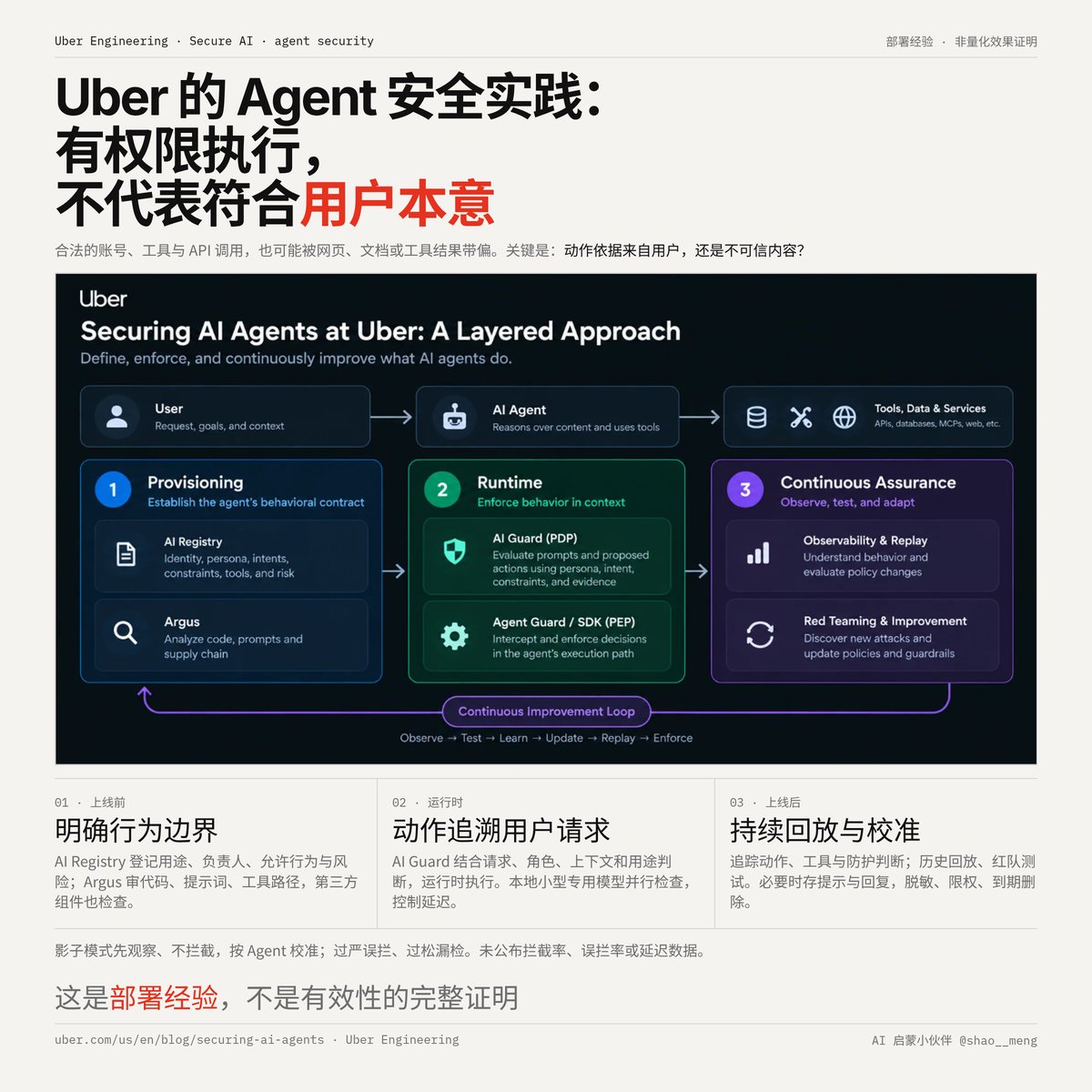
Uber published a defense-in-depth security framework for agentic AI that combines provisioning-time validation, runtime enforcement and continuous assurance. The system traces privileged agent actions back to the user's actual request to counter indirect prompt injection and goal hijacking, and Uber reported no quantitative interception, false-positive or latency figures.
Event version 1.
Key insights
Authorization alone is insufficient
Identity and authorization systems can determine whether a user or service may access a resource, but cannot determine whether an agent's proposed action is appropriate in context. Agents reason over user content, webpages, documents, tools and other agents, shifting part of the attack surface into the semantic layer.
Three-layer defense lifecycle
The framework covers provisioning-time validation through an AI Registry and Argus analysis of code, prompts and tool-call paths, runtime enforcement through AI Guard and runtime components, and continuous assurance through interaction replay and red teaming.
Prompt provenance and evidence chaining
At runtime, prompt provenance and evidence chaining correlate privileged actions back to what the user actually requested, providing an additional defense against indirect prompt injection, goal hijacking and unintended agent behavior.
Tradeoffs over detection
Uber adopted a shadow mode that observes without blocking and calibrates per agent rather than relying on a uniform threshold. The team acknowledged that protections only reduce risk and raise attack cost, and that effectiveness against new prompt injection techniques remains hard to predict.
No quantitative results disclosed
The published material includes no interception rate, false-positive rate or latency figures, so the framework is presented as deployment experience rather than complete proof of effectiveness.