
Vibe Coding: AI coding best practices and workflows
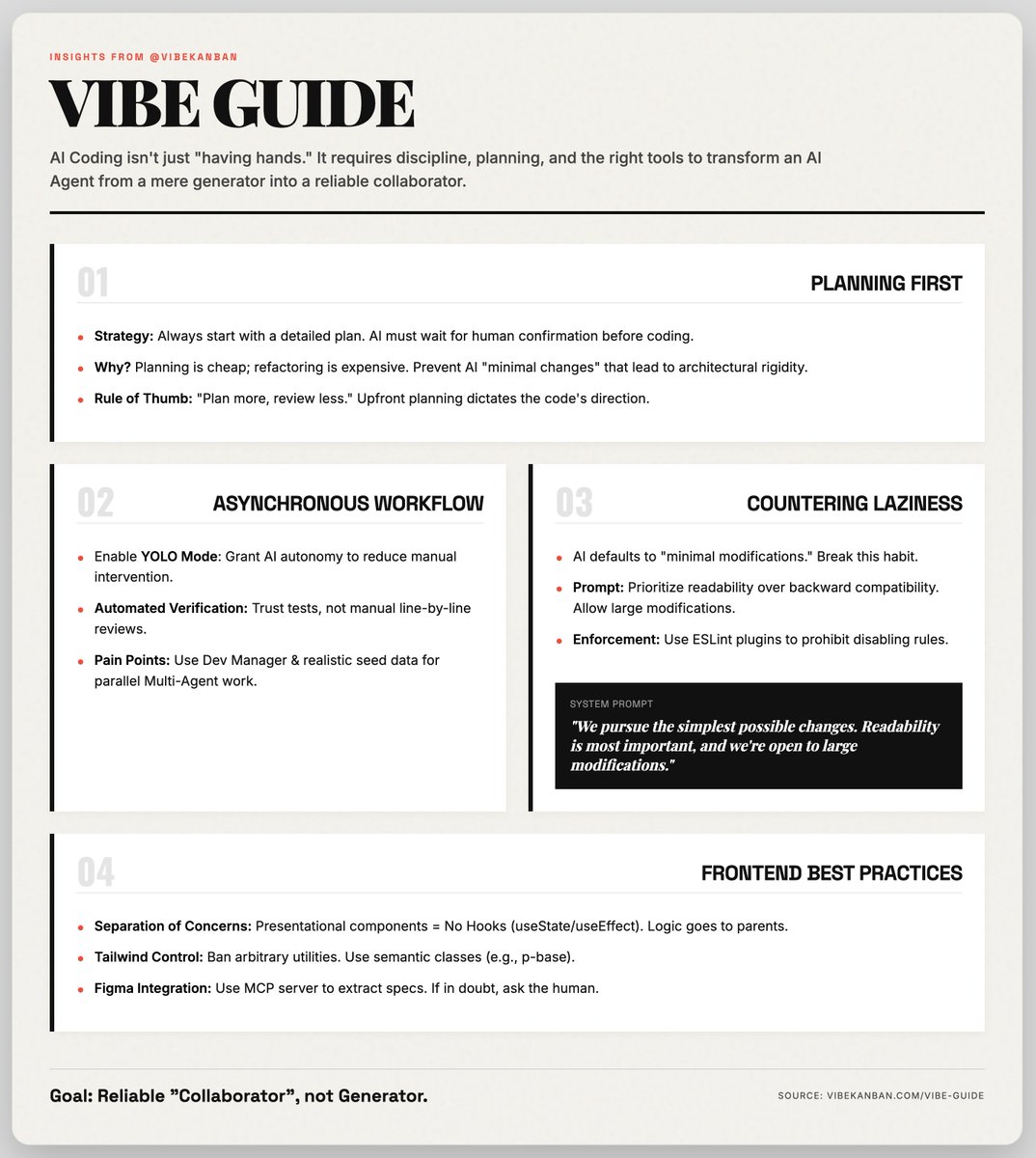
Vibe Coding prescribes planning-first AI workflows and asynchronous agent autonomy. - Require AI to produce plans before coding - Planning reduces costly refactors - Use asynchronous 'YOLO mode' for agent autonomy - Tools: Dev Manager, Figma MCP, ESLint custom rules - Prepare realistic seed data for offline testing - Enforce ESLint plugins to prevent disabling rules - Frontend rules: separate presentational components from logic - Tailwind: restrict to semantic utility classes - Integrate Figma MCP to extract design specs and prompt human when missing
Key insights
Planning-first rule prevents architectural drift
Vibe Coding requires AI to produce detailed plans for any task and to await human confirmation before code execution. The guidance argues that plans are easier to review and adjust, while generated code is expensive to refactor. It states AI agents tend to make minimal changes for backward compatibility which can cause long-term architectural rigidity; enforcing a planning step is intended to steer design direction and reduce later refactor costs.
Asynchronous autonomous agents with tooling improve throughput
The posts recommend asynchronous workflows that let AI agents run independently in the background using a 'YOLO mode' granting controlled autonomy. They specify supporting tools and practices: Dev Manager for development server management, realistic seed data for offline testing, multi-agent parallel work, and robust automated verification to avoid manual line-by-line review. These measures are positioned to turn agents into reliable background collaborators rather than one-off code generators.
Enforce code-quality rules and frontend conventions via tooling
Vibe Coding prescribes countermeasures for AI conservatism and laziness: include system prompts prioritizing simplicity and readability over backward compatibility, and use ESLint plugins to forbid disabling lint rules. For frontend (React + TypeScript), it prescribes strict separation of concerns (no hooks or data fetching in presentational components enforced via ESLint), controlled Tailwind usage limited to semantic classes, and Figma MCP integration so agents extract design tokens and ask humans when exact matches are unavailable.