
Vibe Coding and AI-assisted Development (Armin Ronacher reflections)
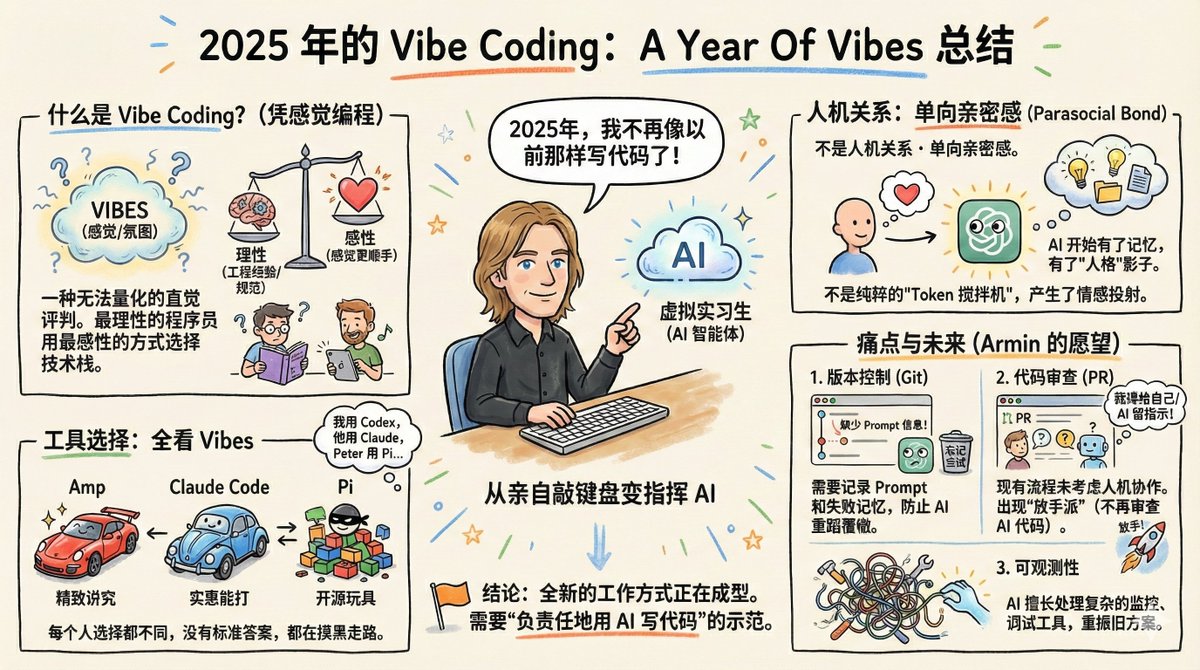
Armin Ronacher describes shifting to Vibe Coding. - By 2025 he no longer writes code as before - He published 36 blog posts in months, 18% of blog since 2007 - He now directs AI to write code, acting as a technical lead - Uses multiple AI tools: Amp, Claude Code, Pi - Amp = refined (Porsche), Claude Code = pragmatic (Volkswagen), Pi = open-source toy - Different users prefer different AI tool 'vibes' - 'Vibes' is an intuitive, non-quantitative selection criterion - He struggled with Model Context Protocol (MCP) - AI tools now retain memory and create parasocial bonds - He questioned calling systems 'agents' due to agency/responsibility - Tooling gaps: prompt/versioning metadata missing in Git/GitHub - Failure histories from prompts are not preserved, causing repeats - Code review interfaces lack formal support for AI-directed PR instructions - Observability and monitoring may be revisited with AI help - Some people deploy AI-generated code without human review; Ronacher continues to inspect code - Vibe Coding requires solid coding and SE skills; prompt writing is easiest - Prompts reused across different models remain effective within months (example reuse reported)
Key insights
Senior engineer shifts to AI-led Vibe Coding
Armin Ronacher wrote a reflective piece titled “A Year Of Vibes” describing that by 2025 he no longer writes code as before and now primarily directs AI to write code. He reported publishing 36 blog posts over several months, representing 18% of his blog’s content since 2007, attributing the productivity change to AI handling tedious implementation work. He characterizes his role as moving from hands-on programmer to a technical lead coordinating virtual interns (AI).
Tool choice driven by subjective 'vibes' not metrics
Ronacher and others described using multiple AI coding tools with distinct tones: Amp (compared to a Porsche) as refined, Claude Code (compared to a Volkswagen) as pragmatic and affordable, and Pi as an open-source hacker toy. Users reported personalized tool mixes (example: Amp, Claude Code, Pi; another user: Codex with GitHub Copilot and Claude Code). The term “vibes” was used to describe an intuitive, non-quantitative criterion for selecting AI programming tools.
Model memory and parasocial bonds complicate human-AI relations
Ronacher reported forming a parasocial bond with AI tools as they acquired memory and persistent context, noting he had tried to treat models as pure token-probability machines but that perspective failed. He questioned terminology such as “agent” because agency implies autonomy and responsibility he believes should remain human. He described unease about how to name and relate to systems that exhibit human-like tendencies but are not people.
Prompt/versioning and failure memory are missing in current workflows
Ronacher identified gaps in existing developer tooling: Git and GitHub lack prompt metadata for AI-generated code, making it hard to judge changes. He argued that failed prompt attempts are valuable and current tools do not preserve failure history, causing models to repeat earlier mistakes if conversation history is deleted. He reported struggling with the Model Context Protocol (MCP) and said existing versioning lacks prompt-level traceability.
AI-assisted workflows clash with current code review and observability
Ronacher noted friction in code review: current GitHub review interfaces do not formally support leaving executable instructions for AI within a PR, and maintainers face many AI-generated PRs that bypass traditional human filtering. He also highlighted observability as an area where AI’s strength in handling complexity could revive underused monitoring and debugging approaches.
Vibe Coding requires traditional coding and engineering skills
A separate post warned that succeeding at Vibe Coding requires solid coding and software engineering knowledge: task decomposition, validation, and debugging remain essential. The post stated prompt-writing is the simplest part, while real training focuses on coding skills rather than prompt craft alone.