
Vibe Coding vs. Vibe Engineering — Armin Ronacher & frontend shifts
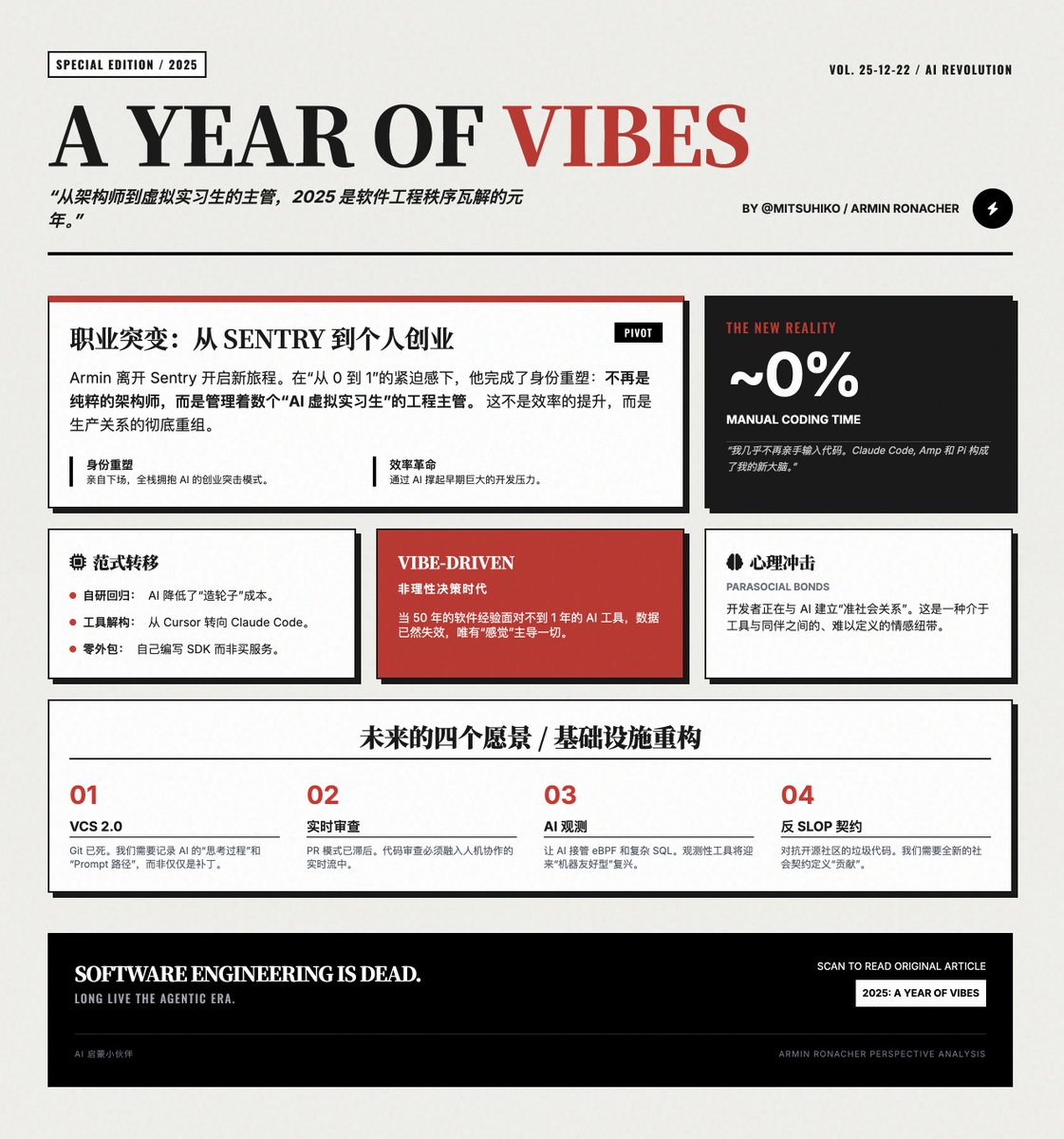
Armin Ronacher and Kitze recount 2025 as a turning point: many developers shifted from hands-on coding to orchestrating AI agents. • Armin left Sentry to start a company and now directs AI ‘virtual interns’ using tools like Claude Code, Amp, Pi, Cursor. • Kitze contrasts 'Vibe Coding' (accepting AI output without scrutiny) with 'Vibe Engineering' (engineers supervising, reviewing, and integrating AI agents). • Common concerns: parasocial bonds with agents, loss of engineering heuristics, and reliance on 'vibes' to choose tools. • Identified infrastructure gaps: new version control capturing prompts/attempts, PR/code-review workflows for AI outputs, observability for agent actions, and norms to limit AI-generated low-quality code. • Predictions: job split, new roles (Vibe Code Fixer), and ongoing need for deep CS knowledge.
Key insights
Vibe Coding vs Vibe Engineering distinction
Kitze defines 'Vibe Coding' as relying on AI-generated code with minimal scrutiny and 'Vibe Engineering' as senior engineers using agents while maintaining deep oversight, architecture control, and review. He argues Vibe Engineering preserves responsibility and quality while leveraging agent speed.
Many senior engineers shifted roles to manage AI-driven development
Armin Ronacher describes his transition from writing code to orchestrating AI tools as a founder: he uses Claude Code, Amp, Pi, and Cursor to generate content and SDKs, treating AI as an extension of his engineering capacity rather than a replacement.
Tool choice driven by 'vibes' amid immature standards
Authors note tool selection is often subjective—based on 'feel' or 'vibes'—because long-term data and standards for AI coding tools are limited; different users prefer different agent stacks (Amp vs Claude Code vs Pi).
Core infrastructure gaps: versioning, code review, observability
Armin and Kitze identify four critical areas needing new design: version control that records prompts and failed attempts; PR and code-review workflows adapted to AI collaboration; observability tooling to let agents analyze systems; and norms to limit low-quality AI-generated contributions.
Psychological and social effects of long-term agent use
Armin reports 'parasocial' attachments forming between developers and AI tools as agents gain memory and personality-like behavior, creating emotional projection despite the models being probabilistic systems without responsibility.
Role polarization and new job types will emerge
Kitze forecasts position stratification: repetitive entry-level work risks replacement by agents, while roles requiring supervision, architecture, and maintaining legacy systems will remain high-value; emerging roles like 'Vibe Code Fixer' are predicted to appear.