
Video & image generation advances and agentic editing
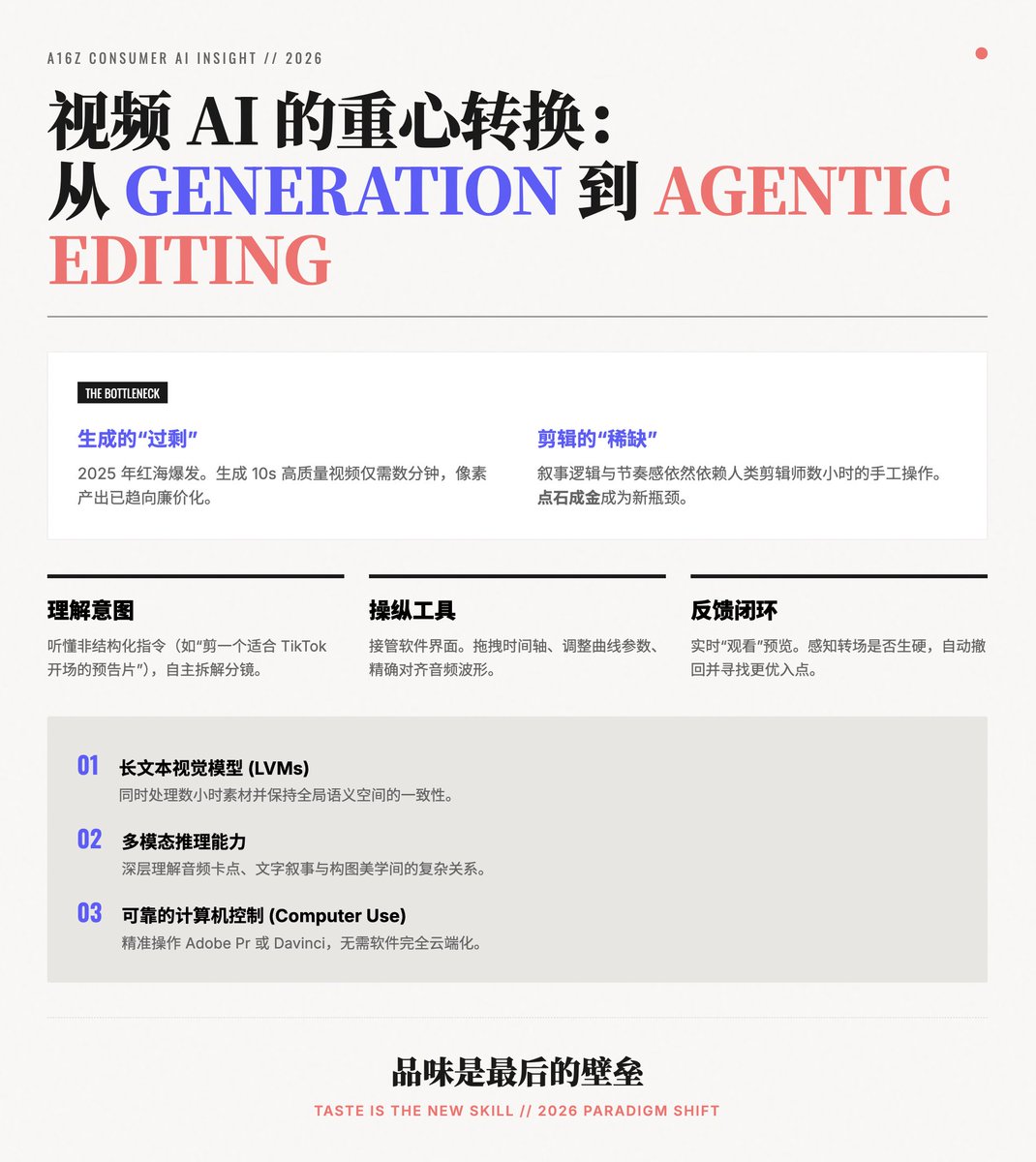
Video AI focus shifts from generation to agentic editing; FLUX.2 delivers sub-second image generation on consumer GPUs.
Key insights
Industry shifts from generation to agentic video editing
Analysis argues the bottleneck in video production moved from content generation to editorial craftsmanship: AI can now create abundant short clips but human-level editing (narrative, rhythm, taste) remains scarce. Agentic video editing systems are defined by intent understanding, tool manipulation (editing software controls) and real-time multi-modal feedback that can iteratively refine cuts, transitions and audio alignment.
FLUX.2 claims 0.5s image generation on consumer GPUs
Black Forest Labs introduced FLUX.2 (klein), a 4B open-source model that generates or edits images in about 0.5 seconds on consumer GPUs (≈13GB VRAM). FLUX.2 supports text generation, image editing and multi-image fusion, with output quality claimed near Midjourney V6 and substantially reduced latency; a 9B variant has a non-commercial license for research.
Parallel design agents and editable WebGL canvases preview future design tools
Demonstrations show WebGL canvases running parallel design agents enabling real-time editable scenes and agent-driven design workflows, pointing to next-generation interfaces where agents operate inside professional design software to accelerate iterative creative production.