
Viggle Releases JST-2 3D-Native World Model With Physics-Native Tokens
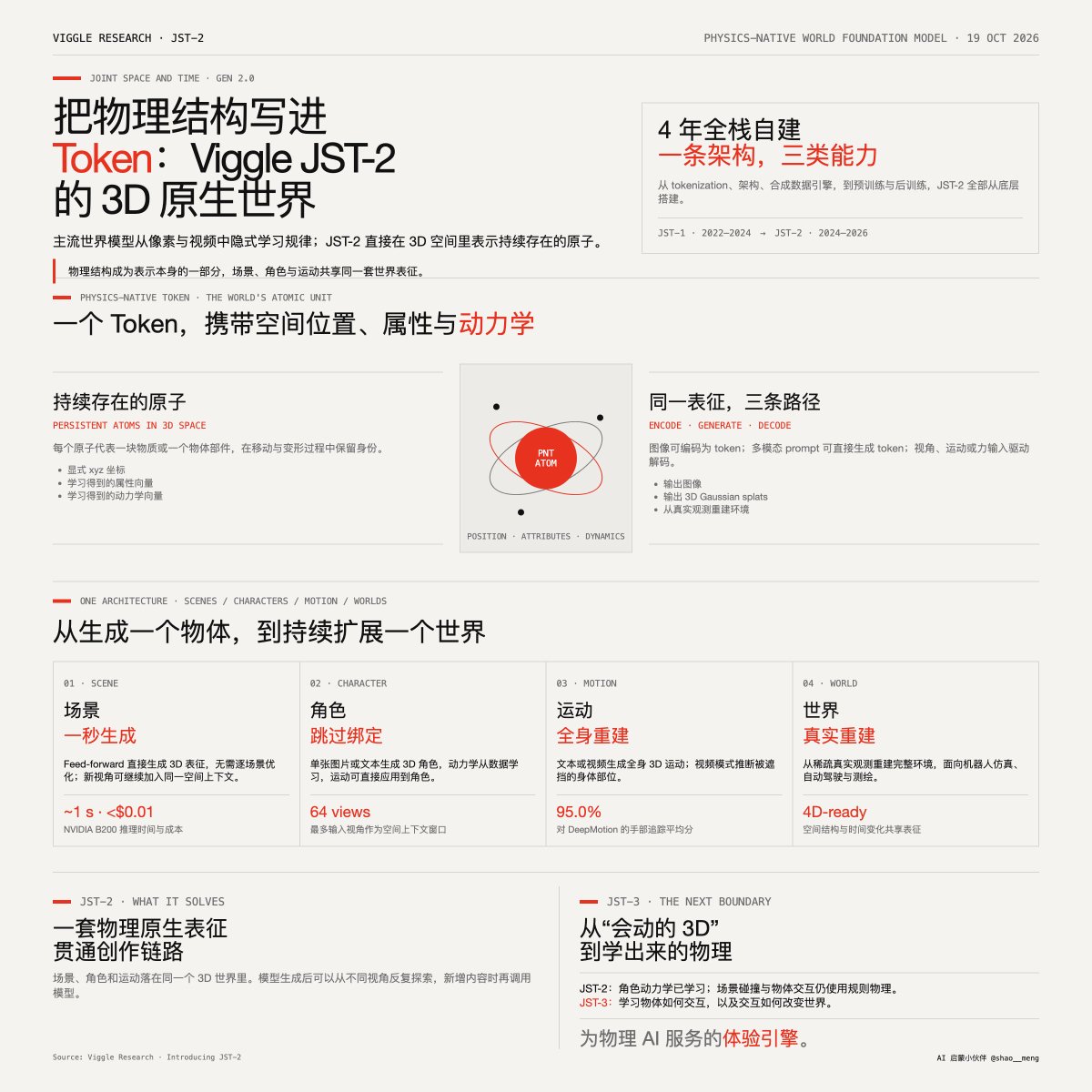
Viggle released JST-2, a world model built entirely in 3D space using Physics-Native Tokens that carry explicit xyz coordinates, learned attribute vectors and learned dynamics vectors. The model generates full 3D scenes in about one second at under $0.01 per scene on B200, produces 3D characters from a single image or text without rigging or skinning, and generates full-body motion from text or video. Viggle reported blind human-preference wins over Meshy, Tripo, Cartwheel and DeepMotion, and outlined JST-3 as extending learned dynamics to object interaction.
Event version 1.
Key insights
Physics embedded in the representation
JST-2 models the world as persistent 3D atoms, each carrying explicit xyz coordinates, a learned attribute vector and a learned dynamics vector. Physical structure is part of the representation rather than inferred from pixel appearance.
Three-component architecture
A JST encoder converts images into physics-native tokens, a JST generator produces tokens directly from multimodal prompts, and a JST decoder combines viewpoint and motion or force inputs to output images or 3D Gaussian splats.
Self-built full stack over four years
Viggle built tokenization, architecture, a data synthesis engine, pretraining and post-training in-house, with JST-1 spanning 2022–2024 and JST-2 spanning 2024–2026. Synthetic data is required because 3D-native training data barely exists in nature.
Unified generation capabilities
JST-2 generates a complete 3D scene in about one second per forward pass at under $0.01 on B200, supports up to 64 input views as a spatial context window, generates 3D characters from one image or text without rigging and skinning, and reconstructs full 3D environments from sparse real observations.
Blind preference results and JST-3 roadmap
In blind human-preference tests JST-2 won 58.4% against Meshy 7.1 and 73.2% against Tripo H3.1 in character generation, and 58.1% against Cartwheel and 89.1% against DeepMotion in video-driven motion, with hand tracking at 95%. JST-3 aims to extend learned dynamics to object interaction, replacing rule-based simulation.