
Workforce Impact & Talent Pipeline in the AI Era
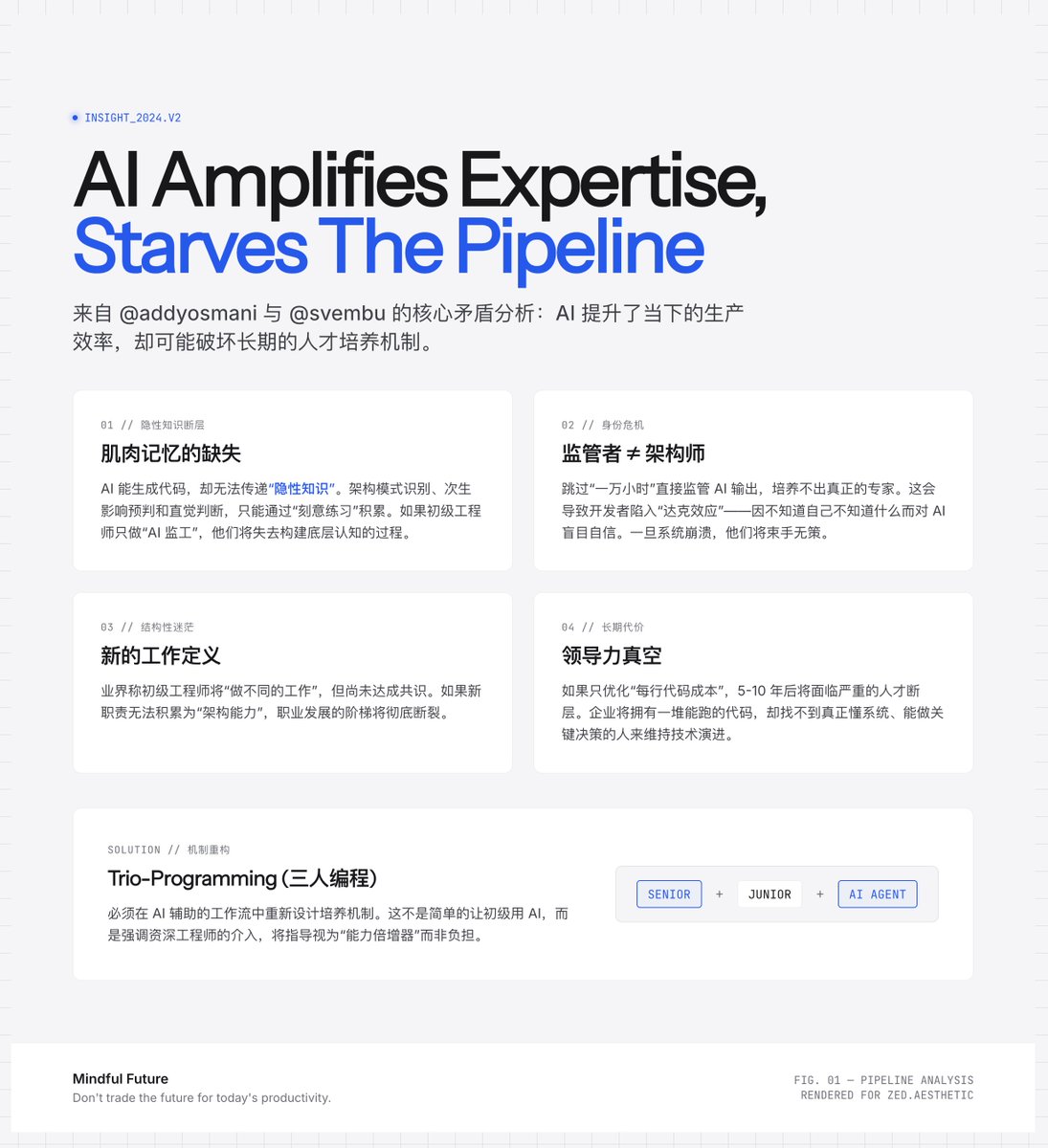
Multiple posts highlight short‑term productivity gains from AI agents alongside long‑term talent and labour risks. Key points: - AI agents increase immediate efficiency but reduce entry‑level roles and hands‑on practice for juniors. - Addy Osmani and Sridhar Vembu warn that removing junior coding work breaks pathways to senior architects; propose Trio‑Programming (Senior + Junior + AI) to preserve mentorship. - MIT research: 11.7% of jobs automatable; companies are shifting budgets from entry‑level hires to AI spending. - Supervisory roles increase psychological load and may be undercompensated. - antirez argues programming won't disappear but programmers who don't use AI will; recommends learning AI tools deeply. - Tailwind CSS reported cutting 75% of engineers as revenue fell 80% despite higher adoption; major models reduced discovery visits causing lost conversions; some large AI firms donated funds. - Opinion: employees should self‑subscribe to AI tools if firms won't; calls to protect displaced workers and adapt hiring/compensation practices.
Key insights
AI agents boost short‑term efficiency but threaten junior training pipelines
Commenters report that agents significantly raise productivity but eliminate many entry‑level tasks that traditionally train future senior engineers. Addy Osmani and Sridhar Vembu highlighted this paradox and proposed Trio‑Programming (Senior + Junior + AI) to retain mentorship and deliberate practice while leveraging AI efficiency.
Automatable job share and corporate budget shifts change workforce roles
MIT research cited that 11.7% of jobs are automatable. Companies are reallocating budgets from hiring junior staff to AI expenditures; remaining workers shift from execution to supervising AI, which increases oversight burden and may lower compensation in practice.
Programmers must adopt AI tools or risk skill obsolescence
antirez and other practitioners state programming will persist but developers who do not integrate AI into workflows will be marginalized. Recommendations include investing weeks to learn AI tooling deeply and finding doubling scenarios where AI increases individual productivity.
Open‑source infrastructure can suffer revenue impacts despite wide use
Tailwind CSS reported a 75% engineering layoff and 80% revenue drop; community usage rose but documentation-driven conversion to paid products fell because AI supplies answers directly, reducing paid conversions. Some major AI firms donated to support Tailwind.
Employees may need to self‑subscribe to AI memberships if employers do not
An opinion argued that AI access functions as a form of production tooling and individuals should self‑subscribe to AI memberships to maintain agency and productivity when employers do not provide access.