
Zhipu AI releases GLM-4.7 flagship model
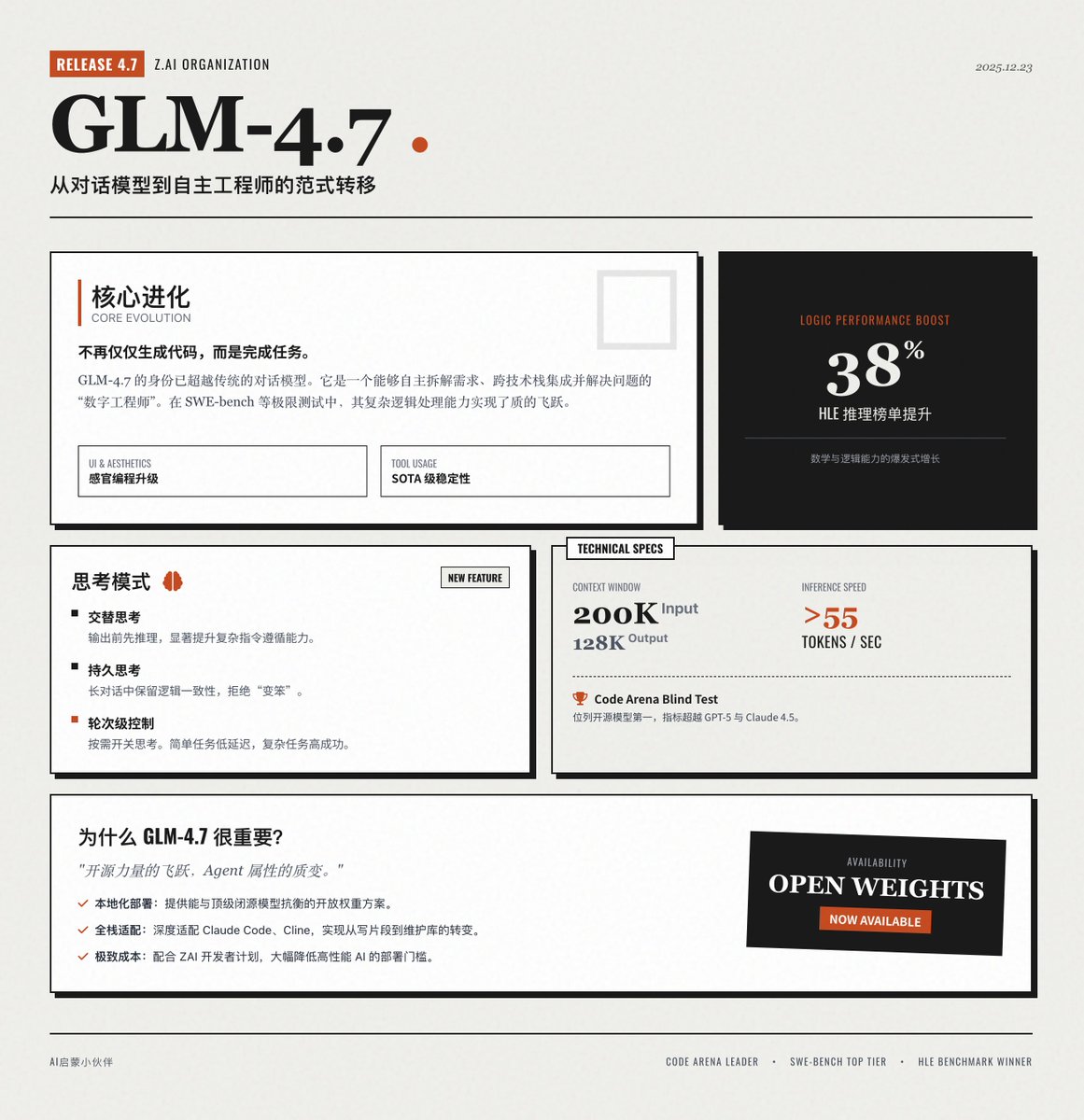
Zhipu AI releases GLM-4.7 flagship model.
Key insights
GLM-4.7 positioned as an agent-capable digital engineer
Zhipu AI announced GLM-4.7 as a flagship upgrade in the GLM series that shifts from simple code generation to autonomous task completion. The model emphasizes multi-language agent programming, autonomous requirement understanding, task decomposition, and cross-stack integration. Zhipu stated GLM-4.7 significantly outperformed its predecessor in complex programming benchmarks such as SWE-bench. The announcement included a generated information card created with GLM-4.7 demonstrating its front-end design capabilities.
Front-end aesthetics and sensory programming improved
Zhipu reported that GLM-4.7 improves UI and front-end aesthetics, producing cleaner, more modern web pages and slide layouts that require less manual style tuning. The model can control layout, color, and typographic ratios to produce visually unified outputs, with examples of generated PPTs and webpages shown in the release materials.
Tool use, multi-step decision stability and reasoning gains
Zhipu described GLM-4.7 as achieving SOTA-level multi-step decision stability on complex tool-usage benchmarks, supporting real-time tool parameter extraction. The model shows major improvements in complex mathematical and logical reasoning, with GLM-4.7 reportedly improving about 38% over GLM-4.6 on hard reasoning leaderboards like HLE.
New multi-dimensional thinking controls and persistence
GLM-4.7 introduces alternating thinking (internal reasoning before output or tool call), persistent thinking (retains prior internal reasoning across multi-turn dialogues), and turn-level thinking controls that let users toggle thinking depth for low-latency or in-depth planning tasks. Zhipu emphasized these modes improve adherence to complex instructions and maintain consistent long-task reasoning.
Technical specs, benchmarks and open-weight significance
Zhipu reported GLM-4.7 supports up to 200K context input and up to 128K single-output content, with inference speeds exceeding 55 tokens/s. In blind tests like Code Arena, GLM-4.7 ranked first among open-source models and surpassed some metrics of GPT-5 and Claude 4.5 Sonnet. Zhipu highlighted open weights as enabling local and private deployment and said a developer program reduces invocation costs for large-scale deployment.